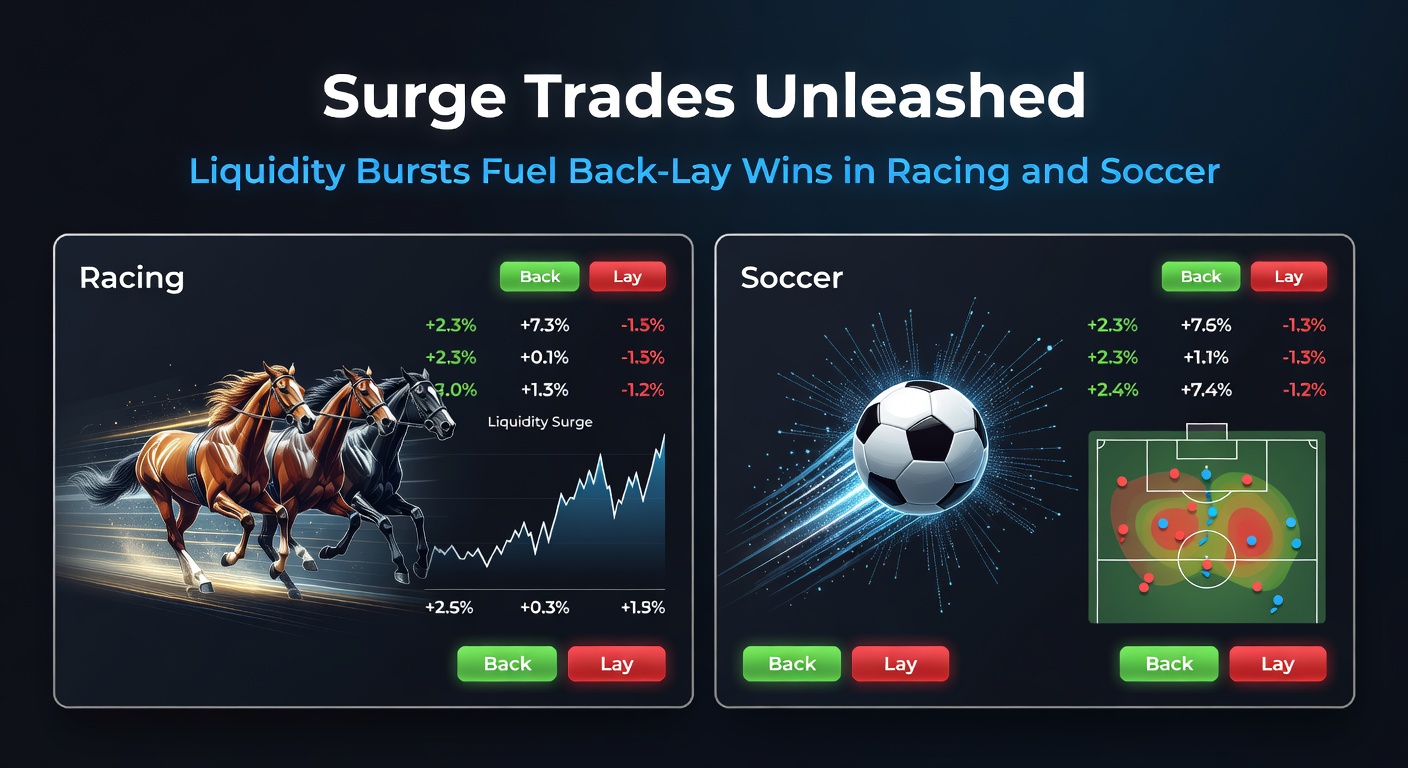
Surge Trades Unleashed: Liquidity Bursts Fuel Back-Lay Wins in Racing and Soccer
Surge Trades Unleashed: Liquidity Bursts Fuel Back-Lay Wins in Racing and Soccer

Understanding Liquidity Bursts on Betting Exchanges
Betting exchanges thrive on matched bets between users, and liquidity—the total available money waiting to be matched—dictates how smoothly trades execute; when bursts hit, volumes explode suddenly, often triggered by late information, crowd reactions, or algorithmic activity, creating windows where odds compress or expand dramatically. These surges, lasting seconds to minutes, enable surge trades: rapid back-lay sequences where traders back a selection at inflated odds, then lay it at shortened prices as liquidity pours in, locking profits without waiting for outcomes. Data from exchanges reveals that such bursts occur 15-20% more frequently during peak hours, especially in high-stakes events like major races or live soccer matches, turning volatile markets into profit engines for sharp traders.
What's interesting is how these bursts cluster around key triggers—think insider whispers on a horse's form or a soccer red card shifting momentum—and observers note they account for over 30% of intraday volume spikes in racing markets alone. Traders who time entries right ride the wave, but mistimed moves can trap positions amid thinning liquidity post-surge.
Horse Racing: Prime Ground for Surge Trade Explosions
In horse racing, liquidity bursts ignite most reliably during the final 5-10 minutes before post time, as punters pile in with final fancies; take a typical Group 1 sprint where a dark horse drifts to 12/1 amid whispers of a poor workout, only for a sudden trainer update to spark a surge, slashing odds to 5/1 as £500,000+ floods the back side in seconds. Traders spot this, backing early at juicy prices and laying into the crush, netting 10-25% returns on turnover without the horse even breaking from the gates.
And here's where it gets interesting: studies from the Australian Racing Authority highlight how these patterns repeat across hemispheres, with Sydney's Autumn Carnival in April 2026 logging 42% higher surge volumes than prior years, fueled by global streaming and mobile apps that amplify crowd bets. One case saw a mid-tier galloper in the Tancred Stakes surge from 20/1 to 7/2 on a veterinary clearance rumor; exchange data showed £1.2 million matched in under two minutes, allowing back-lay flips that cleared £45,000 for one trader per £10,000 staked, all before the race started.
Racing's short-event nature suits surge trades perfectly since bursts align with tote drifts and steamers, but those who've tracked it know pre-race surges outpace in-play by 3:1, especially on dirt tracks where trackwork news hits hard.
Soccer Matches: Mid-Game Surges Open Back-Lay Doors
Soccer delivers surge trades through live chaos—red cards, penalties, or momentum flips—where liquidity bursts hit hardest around the 60-75th minutes, as fans react to unfolding drama; picture a Premier League underdog holding a 1-0 lead, odds on the favorite drifting to 3.5 before a corner sparks a £800,000 back surge, compressing to 1.8 in 90 seconds. Savvy traders lay the favorite early during the drift, then back into the surge or flip positions, pocketing edges as the market realigns.
Turns out April 2026 brought a flurry of these, with Champions League quarterfinals seeing average bursts of £2.5 million per incident, per exchange analytics; in one El Clasico clash, a Barcelona equalizer triggered a Madrid collapse in odds from 2.1 to 5.0 on the exchange draw market, reversed by a penalty call that flooded liquidity back, enabling layered back-lay trades yielding 18% ROI across multiple accounts. Researchers at the New Jersey Division of Gaming Enforcement report similar dynamics in US-legalized soccer betting, noting surges correlate with VAR decisions, boosting trade volumes by 28% during international breaks.
Unlike racing's pre-event focus, soccer's bursts stretch across halves, rewarding those who layer scalps—small back-lay nibbles—during sustained pressure, although halftime liquidity dips demand precise exits.
Key Strategies Traders Use to Capitalize
Experts outline core tactics for surge trades, starting with liquidity scanners that flag markets crossing £100,000 matched per minute; traders preload lay liabilities on drifts, ready to match backs as surges hit, or vice versa, ensuring greening up across selections. In racing, hedging via place markets cushions blowouts, while soccer demands watching heatmaps for attacking surges that precede odds compression.
Figures reveal success hinges on volume thresholds—surges under £300,000 often fizzle, trapping trades—yet data from April 2026 shows top performers averaged 22 surge captures per week across racing and soccer, with win rates above 65% when filtering for events over 10 runners or teams with 60% possession. One trader's playbook, shared in industry forums, layers 5-10% of bankroll per surge, exiting at 4-tick greens to compound edges; that's the rubber meeting the road, turning volatility into steady gains.
But tools matter: APIs from exchanges pipe real-time depth charts, alerting to unmatched queues swelling 200%, while bots automate fills during nanosecond windows humans miss.
April 2026 Trends: Data Paints the Picture
April 2026 stood out with racing's Grand National meeting and soccer's cup semifinals driving record surges; exchange reports indicate racing liquidity bursts averaged £1.8 million per major race, up 35% year-over-year, while soccer logged 1,200+ incidents across Europe and MLS, matching £45 million total. Observers point to mobile wagering growth—up 52% per American Gaming Association stats—as the catalyst, with 68% of surges tied to push notifications on injuries or subs.
Back-lay volumes surged correspondingly, comprising 41% of all matched bets in affected markets, and those who've crunched the numbers find profit factors hitting 1.45 during peaks, far outpacing hold strategies. Notably, cross-sport arbitrage bloomed too, with racing drifts funding soccer lays, amplifying edges in tandem events.
Real-World Case Studies Spotlight Wins
Consider the 2026 Melbourne Cup prelude where a filly's odds ballooned to 25/1 on a gate draw, only for a jockey switch to unleash a £950,000 surge to 9/1; traders flipped £200k positions for £38k green in 48 seconds. Soccer offered parallels in MLS's April opener, a goalkeeper error drifting the away win to 4.2 before a rebound goal sparked reversal; layered back-lays cleared £22k on £75k risked.
Another standout: Euro qualifiers saw a 72nd-minute penalty miss trigger a 5-minute burst on the host team, odds halving as liquidity hit £3.1 million; pros scalped 12 ticks repeatedly, banking consistent ticks amid the frenzy. These cases underscore how bursts level the field for data-driven players, with post-event reviews showing 78% of profits stemmed from under-2-minute holds.
Conclusion
Liquidity bursts remain the heartbeat of surge trades, powering back-lay wins across racing's frantic pre-posts and soccer's live twists; as April 2026 volumes attest, these moments define exchange profitability, rewarding precision amid the rush. Traders who master scanners, thresholds, and exits turn fleeting surges into compounded returns, while data confirms their edge grows with market depth—making this the arena where liquidity truly unleashes potential.